CAT 2025 Slot 1 DILR Q3
- Data Interpretation and Logical Reasoning
- Data Interpretation › Other Charts
- Medium
- Multiple choice
- CAT_2025_SLOT1_DILR_Q03
Data set · questions 1–4
Five countries engage in trade with each other. Each country levies import tariffs on the other countries. The import tariff levied by Country X on Country Y is calculated by multiplying the corresponding tariff percentage with the total imports of Country X from Country Y.
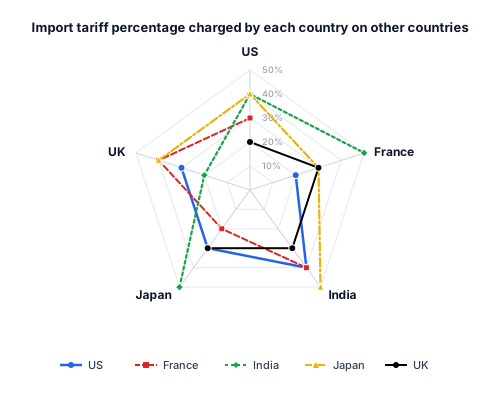
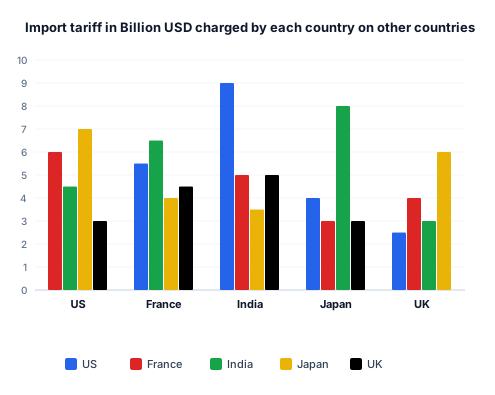
The radar chart below depicts different import tariff percentages charged by each of the five countries on the others. For example, US (the blue line in the chart) charges 20%, 40%, 30%, and 30% import tariff percentages on imports from France, India, Japan, and UK, respectively. The bar chart depicts the import tariffs levied by each county on other countries. For example, US charged import tariff of 3 billion USD on UK.
Assume that imports from one country to another equals the exports from the latter to the former.
The trade surplus of Country X with Country Y is defined as follows.
Trade surplus = Exports from Country X to Country Y – Imports to Country X from Country Y.
A negative trade surplus is called trade deficit.
Question 3
What is the trade surplus/trade deficit of India with UK?
Show answer and solution
Answer: (D)
Deficit of 15.0 Billion USD
Solution
Concept: Bilateral Tariff & International Trade Matrix
Master State Table
| Importing Country (↓) \ Origin (→) | US | France | India | Japan | UK |
|---|---|---|---|---|---|
| US | — | 30.0 | 11.25 | 23.33 | 10.0 |
| France | 18.33 | — | 13.0 | 20.0 | 15.0 |
| India | 30.0 | 20.0 | — | 7.0 | 25.0 |
| Japan | 10.0 | 15.0 | 20.0 | — | 10.0 |
| UK | 12.5 | 16.0 | 10.0 | 15.0 | — |
Question Deduction
• Stepwise Computation of India-UK Trade Flows:
• Flow A: Exports from India to UK:
• Flow B: Imports to India from UK:
• Trade Surplus Calculation:
• Deficit Interpretation:
• Because the surplus is negative (), it constitutes a Trade Deficit of .
• Option Matching:
• Option 1: Surplus of
• Option 2: Surplus of
• Option 3: Deficit of
• Option 4: Deficit of
• Result matches Option 4 perfectly.
Topper Take
• The Surplus vs. Deficit Sign Inversion Trap: A very frequent pitfall is subtracting Exports from Imports () and mistakenly marking "Surplus of 15.0 Billion USD" (Option 1). Keep the directional rule rock-solid:
• Cluster Confusion Trap: Candidates often look for both bars in the same country's cluster. A single country's cluster never contains both sides of a bilateral trade; you MUST read UK's cluster to find India's exports, and India's cluster to find India's imports.
Other questions in this set
- Q1. How much is Japan's export to India worth?
- Q2. Which among the following is the highest?
- Q4. Among France and UK, who has/have trade surplus(es) with US?
Other Charts questions from other CAT papers
- CAT 2024 Slot 1 DILR Q10
- CAT 2024 Slot 1 DILR Q11
- CAT 2024 Slot 1 DILR Q12
- CAT 2024 Slot 1 DILR Q13
- CAT 2021 Slot 3 DILR Q13
Practise this question with timing, notes and your mistake notebook.
Practise in PrepSoc