CAT 2024 Slot 3 DILR Q14
- Data Interpretation and Logical Reasoning
- Data Interpretation › Bar Graphs
- Medium
- Multiple choice
- CAT_2024_SLOT3_DILR_Q14
Data set · questions 14–18
The air-conditioner (AC) in a large room can be operated either in REGULAR mode or in POWER mode to reduce the temperature.
If the AC operates in REGULAR mode, then it brings down the temperature inside the room (called inside temperature) at a constant rate to the set temperature in 1 hour. If it operates in POWER mode, then this is achieved in 30 minutes.
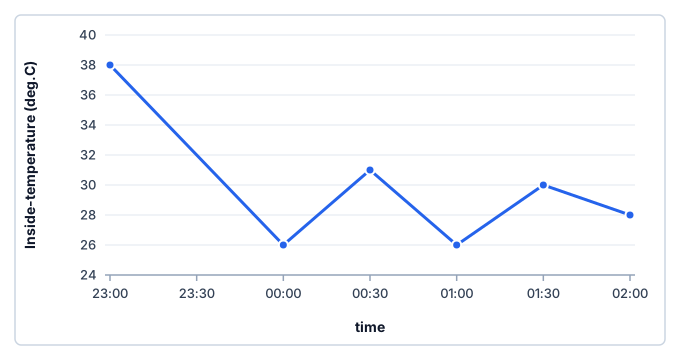
If the AC is switched off, then the inside temperature rises at a constant rate so as to reach the temperature outside at the time of switching off in 1 hour. The temperature outside has been falling at a constant rate from 7 pm onward until 3 am on a particular night. The following graph shows the inside temperature between 11 pm (23:00) and 2 am (2:00) that night.
The following facts are known about the AC operation that night.
-
The AC was turned on for the first time that night at .
-
The AC setting was changed (including turning it on/off, and/or setting different temperatures) only at the beginning of the hour or at minutes after the hour.
-
The AC was used in POWER mode for longer duration than in REGULAR mode during this3-hour period.
Question 14
How many times the AC must have been turned off between 11:01 pm and 1:59 am?
Show answer and solution
Answer: (B)
2
Solution
Concept: Thermodynamic Rate Analysis & Mode Transition Tracking
Master State Table
| Timestamp | Inside Temp () | Mode / Action | State Change | Outside Temp () | |
|---|---|---|---|---|---|
| 23:00 (11:00 pm) | 38 | Initial Turn-on | ON (Cooling towards ) | 38.0 | |
| 23:30 (11:30 pm) | 32 | Cooling Phase 1 | ON (Active) | 37.0 | |
| 00:00 (12:00 am) | 26 | Reached Set Point | Switched OFF (Auto-shutoff) | 36.0 | (Max) |
| 00:30 (12:30 am) | 31 | Thermal Absorption | Switched ON (Power Mode initiated) | 35.0 | |
| 01:00 (01:00 am) | 26 | Reached Set Point | Switched OFF (Auto-shutoff) | 34.0 | |
| 01:30 (01:30 am) | 30 | Thermal Absorption | Switched ON (Cooling initiated) | 33.0 | |
| 02:00 (02:00 am) | 28 | Steady Cooling | ON (Active) | 32.0 |
Question Deduction
We count the number of times the air-conditioner was switched OFF strictly between 11:01 pm and 1:59 am.
• Physics of the AC Operational Cycle:
• The set point of the AC is (the local minimum temperature where cooling terminates).
• Once the room reaches , the compressor shuts off. The room temperature then begins rising linearly toward the ambient outside temperature.
• When the temperature begins dropping again, the AC has been switched back on.
• Identifying Shut-off Events from the Timeline:
• At (): Temperature reaches . In the following half hour, temperature rises from to . This confirms the AC shut off at precisely . (Event 1).
• At (): Temperature reaches again. In the following half hour, temperature rises from to . This confirms the AC shut off at precisely . (Event 2).
• At all other intermediate intervals ( and ), temperature was rising and then turned downward, indicating turn-on events rather than shut-off events.
• Conclusion:
There are exactly two shut-off events within the specified time window ( and ).
Therefore, the AC was turned off 2 times (Option 2).
Topper Take
• Inflection Point Rule: In temperature tracking cycles, shut-off events occur strictly at the local minimums (valleys) of the curve where the slope changes from negative to positive ( at 00:00 and 01:00). Counting the valleys between 11:01 pm and 1:59 am gives exactly 2.
Other questions in this set
- Q15. What was the temperature outside, in degree Celsius, at 1 am?
- Q16. What was the temperature outside, in degree Celsius, at 9 pm?
- Q17. What best can be concluded about the number of times the AC must have either been turned on or the AC temperature…
- Q18. What was the maximum difference between temperature outside and inside temperature, in degree Celsius, between 11:01…
Bar Graphs questions from other CAT papers
- CAT 2025 Slot 2 DILR Q15
- CAT 2025 Slot 2 DILR Q16
- CAT 2025 Slot 2 DILR Q17
- CAT 2025 Slot 2 DILR Q18
- CAT 2022 Slot 3 DILR Q6
Practise this question with timing, notes and your mistake notebook.
Practise in PrepSoc