CAT 2025 Slot 2 DILR Q18
- Data Interpretation and Logical Reasoning
- Data Interpretation › Bar Graphs
- Medium
- Type in the answer (TITA)
- CAT_2025_SLOT2_DILR_Q18
Data set · questions 15–18
The following charts depict details of research papers written by four authors, Arman, Brajen, Chintan, and Devon. The papers were of four types, single-author, two-author, three-author, and four-author, that is, written by one, two, three, or all four of these authors, respectively. No other authors were involved in writing these papers.
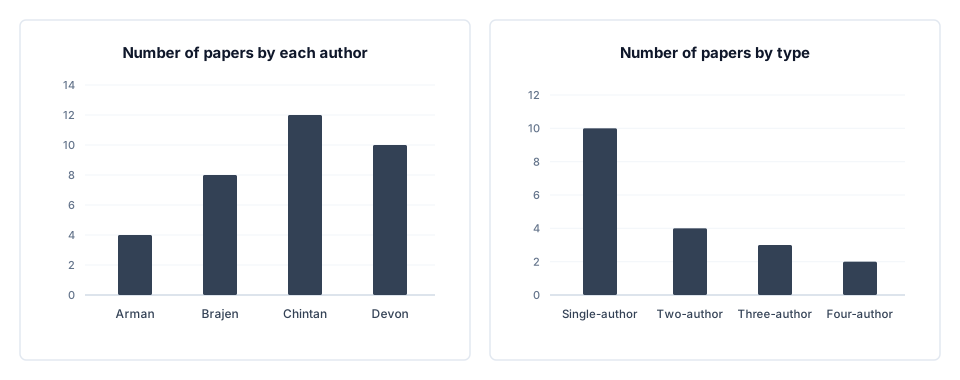
The following additional facts are known.
-
Each of the authors wrote at least one of each of the four types of papers.
-
The four authors wrote different numbers of single-author papers.
-
Both Chintan and Devon wrote more three-author papers than Brajen.
-
The number of single-author and two-author papers written by Brajen were the same.
Question 18
If Devon wrote more than one two-author papers, then how many two-author papers did Chintan write?
Type-in-the-answer (TITA) question: no options are given; enter the value.
Show answer and solution
Answer:
3
Solution
Concept: Authorship Incidence & Diophantine Constraint Satisfaction
Master State Table
| Paper Category | Paper Identifier | Co-authors Included | Omitted Author |
|---|---|---|---|
| Four-Author | Paper Q1 | Arman, Brajen, Chintan, Devon | None |
| Three-Author | Paper T1 | Arman, Chintan, Devon | Brajen |
| Three-Author | Paper T2 | Brajen, Chintan, Devon | Arman |
Question Deduction
The question provides a conditional premise:
"If Devon wrote more than one two-author papers, then how many two-author papers did Chintan write?"
We apply the condition directly to our Master State Table:
• Condition Analysis ():
• In Branch 1:
• Devon's single-author count: .
• Devon's two-author count: .
• Here, , which does not satisfy . Thus, Branch 1 is ruled out by the conditional premise.
• In Branch 2:
• Devon's single-author count: .
• Devon's two-author count: .
• Here, , which strictly satisfies . Thus, the premise isolates Branch 2 as the unique operational state!
• Evaluating Chintan's Two-Author Papers in Branch 2:
• In Branch 2, Chintan's single-author count is .
• Chintan's overall total papers is .
• We know and .
• Therefore, Chintan's two-author count is:
• Alternatively, from the column sum for two-author papers ():
Both derivations converge unconditionally on .
Therefore, Chintan wrote 3 two-author papers.
Topper Take
• The Inequality Boundary Trap ("More than one"): Ensure you do not confuse "more than one" () with "at least one" (). Since every author wrote at least one paper of each type (Fact 1), was already globally true. The condition "more than one" strictly filters out , acting as a discriminator between Branch 1 and Branch 2.
• Pairwise Co-authorship Feasibility Check: A top percentile solver checks if Branch 2 can physically exist as a graph of two-author papers among vertices with degrees :
Other questions in this set
- Q15. What was the total number of two-author and three-author papers written by Brajen?
- Q16. Which of the following statements is/are NECESSARILY true? i. Chintan wrote exactly three two-author papers. ii.…
- Q17. Which of the following statements is/are NECESSARILY true? i. Arman wrote three-author papers only with Chintan and…
Bar Graphs questions from other CAT papers
- CAT 2024 Slot 1 DILR Q14
- CAT 2024 Slot 1 DILR Q15
- CAT 2024 Slot 1 DILR Q16
- CAT 2024 Slot 1 DILR Q17
- CAT 2024 Slot 2 DILR Q10
Practise this question with timing, notes and your mistake notebook.
Practise in PrepSoc