CAT 2025 Slot 2 DILR Q16
- Data Interpretation and Logical Reasoning
- Data Interpretation › Bar Graphs
- Medium
- Multiple choice
- CAT_2025_SLOT2_DILR_Q16
Data set · questions 15–18
The following charts depict details of research papers written by four authors, Arman, Brajen, Chintan, and Devon. The papers were of four types, single-author, two-author, three-author, and four-author, that is, written by one, two, three, or all four of these authors, respectively. No other authors were involved in writing these papers.
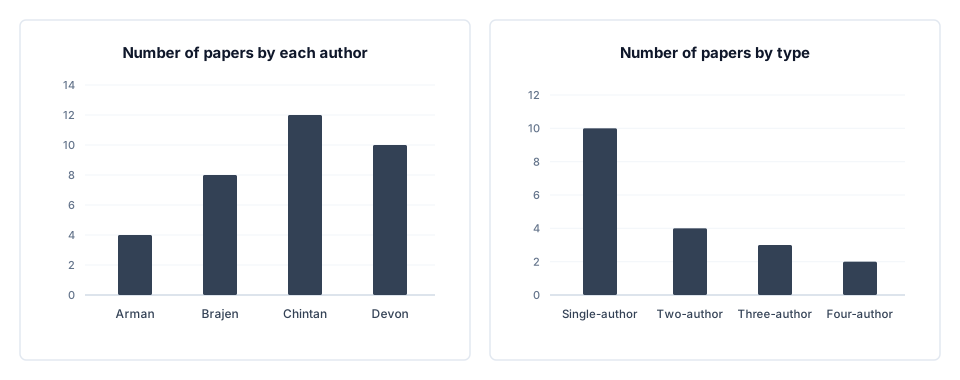
The following additional facts are known.
-
Each of the authors wrote at least one of each of the four types of papers.
-
The four authors wrote different numbers of single-author papers.
-
Both Chintan and Devon wrote more three-author papers than Brajen.
-
The number of single-author and two-author papers written by Brajen were the same.
Question 16
Which of the following statements is/are NECESSARILY true?
i. Chintan wrote exactly three two-author papers.
ii. Chintan wrote more single-author papers than Devon.
Show answer and solution
Answer: (C)
Neither i nor ii
Solution
Concept: Authorship Incidence & Diophantine Constraint Satisfaction
Master State Table
| Paper Category | Paper Identifier | Co-authors Included | Omitted Author |
|---|---|---|---|
| Four-Author | Paper Q1 | Arman, Brajen, Chintan, Devon | None |
| Three-Author | Paper T1 | Arman, Chintan, Devon | Brajen |
| Three-Author | Paper T2 | Brajen, Chintan, Devon | Arman |
Question Deduction
We are asked to assess which of the following statements is/are NECESSARILY true:
• Statement i: Chintan wrote exactly three two-author papers.
• Statement ii: Chintan wrote more single-author papers than Devon.
Let us evaluate both statements across the two valid branches derived in the Master State Table:
• Audit of Statement i (Chintan's Two-Author Count):
• In Branch 1: Chintan wrote single-author papers, which forces two-author papers.
• In Branch 2: Chintan wrote single-author papers, which forces two-author papers.
• For a statement to be necessarily true, it must hold in all valid mathematical configurations.
• Because in Branch 1, Chintan did not write exactly three two-author papers in Branch 1.
• Hence, Statement i is NOT necessarily true.
• Audit of Statement ii (Chintan vs Devon Single-Author Comparison):
• In Branch 1: Chintan wrote single-author papers, while Devon wrote single-author papers. Here, ().
• In Branch 2: Chintan wrote single-author papers, while Devon wrote single-author papers. Here, ().
• In Branch 1, Chintan wrote fewer single-author papers than Devon.
• Hence, Statement ii is NOT necessarily true.
• Options Comparison Matrix:
| Option | Stated Claim | Evaluation Against Branches | Correctness Status |
|---|---|---|---|
| Option 1 | Only ii | False in Branch 1 () | Incorrect |
| Option 2 | Both i and ii | Both statements fail in Branch 1 | Incorrect |
| Option 3 | Neither i nor ii | Both statements fail to hold unconditionally | Correct |
| Option 4 | Only i | False in Branch 1 () | Incorrect |
Therefore, neither statement is necessarily true, corresponding to Option 3.
Topper Take
• The Confirmation Bias Trap: Candidates who arbitrarily test only one branch (often Branch 2, where , yielding and ) observe that both Statement i and Statement ii appear true, leading them to pick "Both i and ii" (Option 2). In CAT DILR, whenever an equality partition (here ) permits symmetric solutions (), candidates must explicitly test whether both assignments remain viable under column and row constraints.
• Surgical Counterexample Technique: To disprove a "necessarily true" claim, one only needs a single valid counterexample. Showing that Branch 1 ( and ) satisfies all passage constraints immediately refutes both Statement i and Statement ii in one swift stroke, eliminating Options 1, 2, and 4 in seconds.
Other questions in this set
- Q15. What was the total number of two-author and three-author papers written by Brajen?
- Q17. Which of the following statements is/are NECESSARILY true? i. Arman wrote three-author papers only with Chintan and…
- Q18. If Devon wrote more than one two-author papers, then how many two-author papers did Chintan write?
Bar Graphs questions from other CAT papers
- CAT 2024 Slot 1 DILR Q14
- CAT 2024 Slot 1 DILR Q15
- CAT 2024 Slot 1 DILR Q16
- CAT 2024 Slot 1 DILR Q17
- CAT 2024 Slot 2 DILR Q10
Practise this question with timing, notes and your mistake notebook.
Practise in PrepSoc