CAT 2021 Slot 3 DILR Q14
- Data Interpretation and Logical Reasoning
- Data Interpretation › Other Charts
- Easy
- Multiple choice
- CAT_2021_SLOT3_DILR_Q14
Data set · questions 13–16
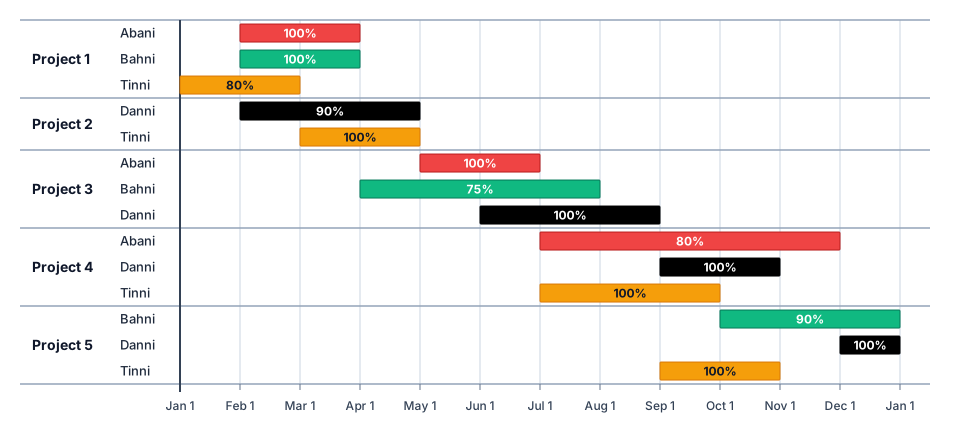
The figure above shows the schedule of four employees – Abani, Bahni, Danni and Tinni –whom Dhoni supervised in 2020. Altogether there were five projects which started and concluded in 2020 in which they were involved. For each of these projects and for each employee, the starting day was at the beginning of a month and the concluding day was the end of a month, and these are indicated by the left and right end points of the corresponding horizontal bars. The number within each bar indicates the percentage of assigned work completed by the employee for that project, as assessed by Dhoni.
For each employee, his/her total project-month (in 2020) is the sum of the number of months(s)he worked across the five project, while his/her annual completion index is the weight age average of the completion percentage assigned from the different projects, with the weights being the corresponding number of months she worked in these projects. For each project, the total employee-month is the sum of the number of months four employees worked in this project, while its completion index is the weight age average of the completion percentage assigned for the employees who worked in this project, with the weights being the corresponding number of months they worked in this project.
Question 14
Which employees did not work in multiple projects for any of the months in 2020?
Show answer and solution
Answer: (D)
Only Abani, Bahni and Danni
Solution
Concept: Timeline Disjointness, Concurrent Scheduling Analysis & Overlap Detection
Master State Table
| Project | Active Span | Duration | Abani | Bahni | Danni | Tinni | Total Emp-Mo |
|---|---|---|---|---|---|---|---|
| Project 1 | Jan 1 – Apr 1 | 3 Months | Feb–Apr (2 mo, 100%) | Feb–Apr (2 mo, 100%) | — | Jan–Mar (2 mo, 80%) | 6 Months |
| Project 2 | Feb 1 – May 1 | 3 Months | — | — | Feb–May (3 mo, 90%) | Mar–May (2 mo, 100%) | 5 Months |
| Project 3 | Apr 1 – Sep 1 | 5 Months | May–Jul (2 mo, 100%) | Apr–Aug (4 mo, 75%) | Jun–Sep (3 mo, 100%) | — | 9 Months |
| Project 4 | Jul 1 – Dec 1 | 5 Months | Jul–Dec (5 mo, 80%) | — | Sep–Nov (2 mo, 100%) | Jul–Oct (3 mo, 100%) | 10 Months |
| Project 5 | Sep 1 – Jan 1 | 4 Months | — | Oct–Jan (3 mo, 90%) | Dec–Jan (1 mo, 100%) | Sep–Nov (2 mo, 100%) | 6 Months |
| Total Project-Months | — | — | 9 Months | 9 Months | 9 Months | 9 Months | 36 Months |
| Annual Completion Index | — | — | 88.89% | 85.56% | 96.67% | 95.56% | — |
Question Deduction
• Understanding Multi-Project Concurrency:
• An employee works on multiple projects in a month if their project assignments overlap during that calendar month.
• To find who did not work on multiple projects in any month, we verify interval disjointness for all four employees.
• Evaluating Monthly Schedules for Each Employee:
• Abani: Active in Feb–Mar (, 2 mo), May–Jun (, 2 mo), and Jul–Nov (, 5 mo). All active intervals are disjoint; Abani worked on at most 1 project per month.
• Bahni: Active in Feb–Mar (, 2 mo), Apr–Jul (, 4 mo), and Oct–Dec (, 3 mo). Active intervals are pairwise disjoint; Bahni never worked on multiple projects concurrently.
• Danni: Active in Feb–Apr (, 3 mo), Jun–Aug (, 3 mo), Sep–Oct (, 2 mo), and Dec (, 1 mo). Active intervals have zero overlap; Danni never worked on multiple projects simultaneously.
• Tinni: Active in Jan–Feb (, 2 mo), Mar–Apr (, 2 mo), Jul–Sep (, 3 mo), and Sep–Oct (, 2 mo). In September, Tinni worked concurrently on Project 4 (Jul 1 – Oct 1) and Project 5 (Sep 1 – Nov 1).
• Synthesizing the Result:
• Tinni is the unique employee who worked on multiple projects in a month (September).
• Abani, Bahni, and Danni had strictly disjoint project intervals across all 12 months.
• Option Matching / Numerical Answer:
• Matches Option 4 (Only Abani, Bahni and Danni).
Topper Take
• Visual Sweep: Vertically check each person's timeline. Only Tinni has overlapping bars (Project 4 and Project 5 both active in September).
• Abani, Bahni, and Danni have strictly sequential bars, instantly confirming Option 4.
Other questions in this set
- Q13. Which of the following statements is/are true? I: The total project-month was the same for the four employees. II: The…
- Q15. The project duration, measured in terms of the number of months, is the time duringwhich at least one employee worked…
- Q16. The list of employees in decreasing order of annual completion index is:
Other Charts questions from other CAT papers
- CAT 2025 Slot 1 DILR Q1
- CAT 2025 Slot 1 DILR Q2
- CAT 2025 Slot 1 DILR Q3
- CAT 2025 Slot 1 DILR Q4
- CAT 2025 Slot 3 DILR Q6
Practise this question with timing, notes and your mistake notebook.
Practise in PrepSoc