CAT 2021 Slot 2 DILR Q1
- Data Interpretation and Logical Reasoning
- Data Interpretation › Bar Graphs
- Easy
- Type in the answer (TITA)
- CAT_2021_SLOT2_DILR_Q01
Data set · questions 1–4
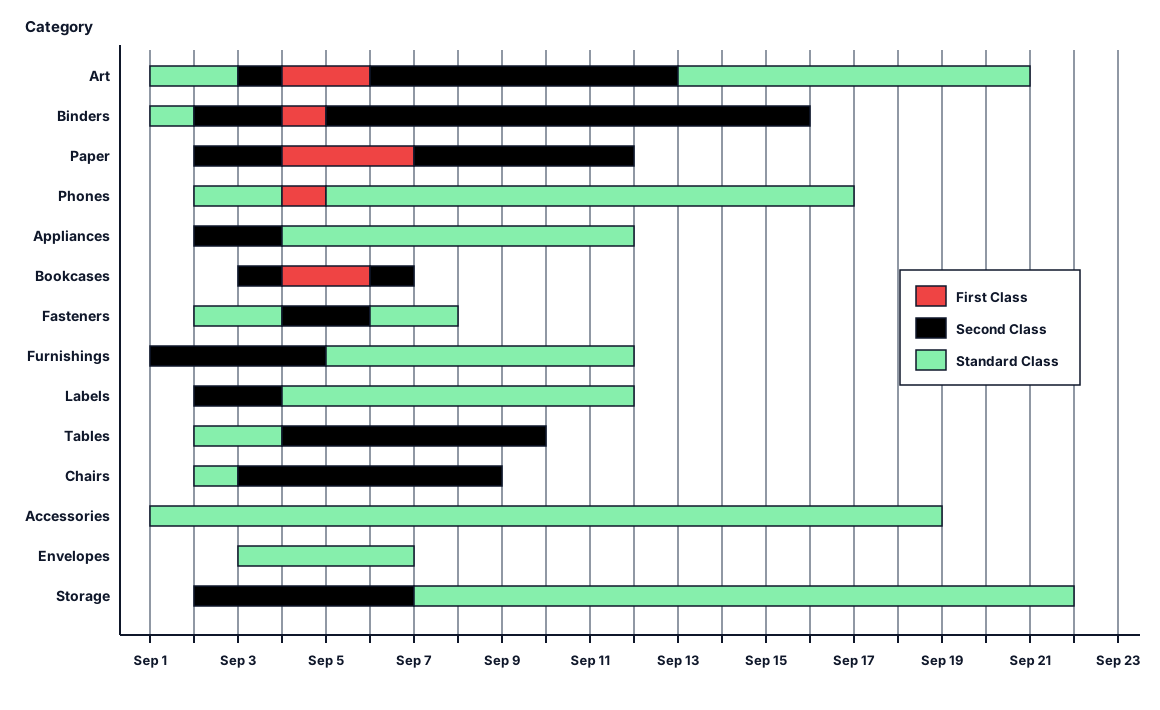
The different bars in the diagram above provide information about different orders in various categories (Art, Binders, ....) that were booked in the first two weeks of September of a store for one client. The colour and pattern of a bar denotes the ship mode (First Class / Second Class / Standard Class). The left end point of a bar indicates the booking day of the order, while the right end point indicates the dispatch day of the order. The difference between the dispatch day and the booking day (measured in terms of the number of days) is called the processing time of the order.
For the same category, an order is considered for booking only after the previous order of the same category is dispatched. No two consecutive orders of the same category had identical ship mode during this period.
For example, there were only two orders in the furnishing category during this period. The first one was shipped in the Second Class. It was booked on Sep 1 and dispatched on Sep 5. The second order was shipped in the Standard class. It was booked on Sep 5 (although the order might have been placed before that) and dispatched on Sep 12. So the processing times were 4 and 7 days respectively for these orders.
Question 1
How many days between Sep 1 and Sep 14 (both inclusive) had no booking from this client considering all the above categories?
Type-in-the-answer (TITA) question: no options are given; enter the value.
Show answer and solution
Answer:
6
Solution
Concept: Gantt-Chart Schedule Decoding, Interval Analysis & Discrete Calendar Coverage
Master State Table
| Category | Standard Class (Booked–Dispatched) | First Class (Booked–Dispatched) | Second Class (Booked–Dispatched) | Total Orders | Total Days |
|---|---|---|---|---|---|
| Accessories | Sep 1–19 (18d) | — | — | 1 | 18 |
| Appliances | Sep 4–12 (8d) | — | Sep 2–4 (2d) | 2 | 10 |
| Art | Sep 1–3 (2d), Sep 13–21 (8d) | Sep 4–6 (2d) | Sep 3–4 (1d), Sep 6–13 (7d) | 5 | 20 |
| Binders | Sep 1–2 (1d), Sep 4–5 (1d) | Sep 2–4 (2d) | Sep 5–16 (11d) | 4 | 15 |
| Bookcases | — | Sep 4–6 (2d) | Sep 3–4 (1d), Sep 6–7 (1d) | 3 | 4 |
| Chairs | Sep 2–3 (1d) | — | Sep 3–9 (6d) | 2 | 7 |
| Envelopes | Sep 3–7 (4d) | — | — | 1 | 4 |
| Fasteners | Sep 2–4 (2d), Sep 6–8 (2d) | — | Sep 4–6 (2d) | 3 | 6 |
| Furnishings | Sep 5–12 (7d) | — | Sep 1–5 (4d) | 2 | 11 |
| Labels | Sep 4–12 (8d) | — | Sep 1–3 (2d) | 2 | 10 |
| Paper | — | Sep 4–7 (3d) | Sep 2–4 (2d), Sep 7–12 (5d) | 3 | 10 |
| Phones | Sep 2–4 (2d), Sep 5–17 (12d) | Sep 4–5 (1d) | — | 3 | 15 |
| Storage | Sep 7–22 (15d) | — | Sep 2–7 (5d) | 2 | 20 |
| Tables | Sep 2–4 (2d) | — | Sep 4–10 (6d) | 2 | 8 |
| Total | 17 Orders | 5 Orders | 13 Orders | 35 | 148 |
Question Deduction
• Booking Day Interpretation:
• The left endpoint of each bar in the schedule denotes the order's booking day.
• Window: (14 days inclusive). Count days with zero bookings across all categories.
• Compiling Active Booking Dates:
• Scanning booking start days across all 35 orders:
• **Sep 1**: Accessories, Art, Binders, Furnishings, Labels.

• **Sep 2**: Appliances, Chairs, Fasteners, Paper, Phones, Storage, Tables.

• **Sep 3**: Art, Bookcases, Chairs, Envelopes.

• **Sep 4**: Appliances, Art, Binders, Bookcases, Fasteners, Labels, Paper, Phones, Tables.

• **Sep 5**: Binders, Furnishings, Phones.

• **Sep 6**: Art, Bookcases, Fasteners.

• **Sep 7**: Paper, Storage.

• **Sep 13**: Art.
• The set of active booking days is:
$$\mathcal{B} = \{1, 2, 3, 4, 5, 6, 7, 13\}$$
• Total active booking days in the target window days.
• Evaluating Days with Zero Bookings:
• Inactive days in are:
$$\{8, 9, 10, 11, 12, 14\}$$
• Over Sep 8–12 and on Sep 14, ongoing orders were processed, but zero fresh orders were booked.
• Count of days with no booking days.
• Numerical Answer:
• 6.
Topper Take
• Interval Triage: Extract the unique left endpoints in : ( days). The days with no bookings are .
Other questions in this set
- Q2. What was the average processing time of all orders in the categories which had only one type of ship mode?
- Q3. The sequence of categories Art, Binders, Paper and Phones in decreasing order of average processing time of their…
- Q4. Approximately what percentage of orders had a processing time of one day during the period Sep 1 to Sep 22 (both dates…
Bar Graphs questions from other CAT papers
- CAT 2025 Slot 2 DILR Q15
- CAT 2025 Slot 2 DILR Q16
- CAT 2025 Slot 2 DILR Q17
- CAT 2025 Slot 2 DILR Q18
- CAT 2024 Slot 1 DILR Q14
Practise this question with timing, notes and your mistake notebook.
Practise in PrepSoc