CAT 2021 Slot 2 DILR Q19
- Data Interpretation and Logical Reasoning
- Logical Reasoning › Games & Tournaments
- Hard
- Multiple choice
- CAT_2021_SLOT2_DILR_Q19
Data set · questions 15–20
Ten objects o1, o2, …, o10 were distributed among Amar, Barat, Charles, Disha, and Elise. Each item went to exactly one person. Each person got exactly two of the items, and this pair of objects is called her/his bundle.
The following table shows how each person values each object.
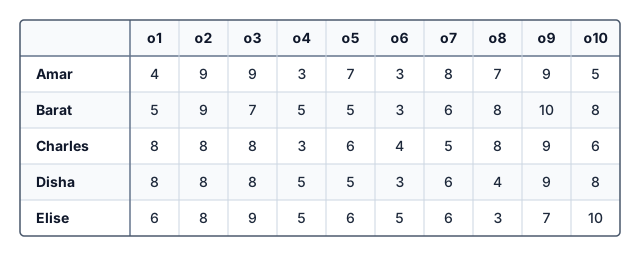
The value of any bundle by a person is the sum of that person's values of the objects in that bundle. A person X envies another person Y if X values Y 's bundle more than X 's own bundle.
For example, hypothetically suppose Amar's bundle consists of and , and Barat's bundle consists of and . Then Amar values his own bundle at and Barat's bundle at
. Hence Amar does not envy Barat. On the other hand, Barat values his own bundle at and Amar's bundle at . Hence Barat envies Amar.
The following facts are known about the actual distribution of the objects among the five people.
-
If someone's value for an object is , then she/he received that object.
-
Objects o1, o2, and o3 were given to three different people.
-
Objects and were given to different people.
-
Three people value their own bundles at . No one values her/his own bundle at a number higher than .
-
Disha values her own bundle at an odd number. All others value their own bundles at an even number.
-
Some people who value their own bundles less than envy some other people who value their own bundle at . No one else envies others.
Question 19
Object o5 was given to
Show answer and solution
Answer: (B)
Elise
Solution
Concept: Deductive Grid Assignment, Parity & Bounded Sum Constraints, Envy Elimination
Master State Table
| Person | Assigned Bundle | Object Breakdown (Own Values) | Own Bundle Value | Parity | Envy Directed Towards |
|---|---|---|---|---|---|
| Amar | 12 | Even () | Barat (17), Charles (16) | ||
| Barat | 16 | Even () | None | ||
| Charles | 16 | Even () | None | ||
| Disha | 13 | Odd () | Barat (15) | ||
| Elise | 16 | Even () | None |
Question Deduction
• Filtering Candidates for o5:
• Clue 1 gives to Barat and to Elise.
• Barat takes to satisfy parity and upper bound 16 (), ruling out for Barat.
• Charles requires two objects valued at 8 to reach 16, ruling out (valued at 6 by Charles).
• Hence, can only belong to Elise, Amar, or Disha.
• Evaluating Elise's Second Object:
• Elise holds (value 10). To satisfy even parity and max bound 16, her second object must have an even value to Elise.
• In Elise's row, only (value 6) and (value 6) qualify.
• Thus, Elise's bundle is either or .
• Refuting Elise Receiving o1:
• Suppose Elise receives .
• Charles holds . Clue 2 forces to either Amar or Disha.
• Subcase A: goes to Disha.
• Amar receives two objects from $\{o_4, o_5, o_6\}$, scoring $3 + 7 = 10$ or $3 + 3 = 6$.

• Amar evaluates Disha's bundle at $9 + 3 = 12$ or $9 + 7 = 16$, envying Disha. Since both score $< 16$, this violates Clue 6.
• Subcase B: goes to Amar.
• Amar values $o_2$ at 9 (odd). To remain even (Clue 5), Amar must take $o_4$ or $o_6$.

• Disha receives the remaining two from $\{o_4, o_5, o_6\}$, scoring $5 + 3 = 8$ or $5 + 5 = 10$ (both even).

• This directly violates Clue 5 (Disha's score must be odd).
• Hence, Elise cannot receive .
• Conclusive Assignment of o5:
• Since Elise must receive or , and is ruled out, Elise MUST receive !
• Elise's bundle is with an own valuation of .
• Option Matching:
• Object was given to Elise.
• Matches Option 2 (Elise).
Topper Take
• Forced Choice for Elise: Elise must pair (value 10) with an object valued at 6 ( or ) to reach 16. Giving to Elise breaks parity for Disha or creates illegal cross-envy between Amar and Disha. Hence must go to Elise.
Other questions in this set
- Q15. What BEST can be said about object o8?
- Q16. Who among the following envies someone else?
- Q17. What is Amar's value for his own bundle?
- Q18. Object o4 was given to
- Q20. What BEST can be said about the distribution of object o1?
Games & Tournaments questions from other CAT papers
- CAT 2025 Slot 1 DILR Q14
- CAT 2025 Slot 1 DILR Q15
- CAT 2025 Slot 1 DILR Q16
- CAT 2025 Slot 1 DILR Q17
- CAT 2025 Slot 1 DILR Q18
Practise this question with timing, notes and your mistake notebook.
Practise in PrepSoc