CAT 2019 Slot 1 DILR Q17
- Data Interpretation and Logical Reasoning
- Logical Reasoning › Routes & Networks
- Medium
- Multiple choice
- CAT_2019_SLOT1_DILR_Q17
Data set · questions 17–20
The figure below shows the street map for a certain region with the street intersections marked from a through I. A person standing at an intersection can see along straight lines to other intersections that are in her line of sight and all other people standing at these intersections. For example, a person standing at intersection g can see all people standing at intersections b, c, e, f, h, and k. In particular, the person standing at intersection g can see the person standing at intersection e irrespective of whether there is a person standing at intersection f.
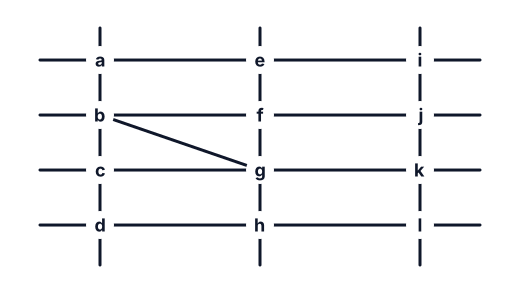
Six people U, V, W, X, Y, and Z, are standing at different intersections. No two people are standing at the same intersection.
The following additional facts are known.
- X, U, and Z are standing at the three corners of a triangle formed by three street segments.
- X can see only U and Z.
- Y can see only U and W.
- U sees V standing in the next intersection behind Z.
- W cannot see V or Z.
- No one among the six is standing at intersection d.
Question 17
Who is standing at intersection a?
Show answer and solution
Answer: (A)
No one
Solution
Concept: Planar Grid Graph Invariance, Triangle Identification & Line-of-Sight Deduction
Master State Table
| Intersection | Position | Resident | Visible Intersections | Visible People | Invariant Basis |
|---|---|---|---|---|---|
| a | Row 1, Col 1 | None | b, c, d, e, i | X, V | Empty; seen by X at b (Clue 2) |
| b | Row 2, Col 1 | X | a, c, d, f, g, j | Z, U | Vertex of ; sees only U, Z (Clue 2) |
| c | Row 3, Col 1 | None | a, b, d, g, k | X, U, Y | Empty; seen by X at b (Clue 2) |
| d | Row 4, Col 1 | None | a, b, c, h, l | X, W | Empty per Clue 6 |
| e | Row 1, Col 2 | V | a, f, g, h, i | Z, U | Fixed behind Z(f) along Col 2 (Clue 4) |
| f | Row 2, Col 2 | Z | b, e, g, h, j | X, V, U | Vertex of ; collinear U-Z-V |
| g | Row 3, Col 2 | U | b, c, e, f, h, k | X, V, Z, Y | Vertex of ; sees V behind Z |
| h | Row 4, Col 2 | None | d, e, f, g, l | V, Z, U, W | Empty; visible to V, Z (Clue 5) |
| i | Row 1, Col 3 | None | a, e, j, k, l | V, Y, W | Empty; avoids extra visibility |
| j | Row 2, Col 3 | None | b, f, i, k, l | X, Z, Y, W | Empty; seen by X at b (Clue 2) |
| k | Row 3, Col 3 | Y | c, g, i, j, l | U, W | Fixed at (3,3); sees only U, W (Clue 3) |
| l | Row 4, Col 3 | W | d, h, i, j, k | Y | Fixed at (4,3); blind to V, Z (Clue 5) |
Question Deduction
• Triangle Identification (Clue 1):
• The street grid contains a single diagonal segment linking and .
• Only two triangles exist: and . Clue 1 places on one of them.
• Collinear Alignment & Resolution (Clues 4 & 6):
• Clue 4 requires to be collinear along a straight grid line.
• In : vertical alignment forces (violates Clue 6) or (forces to see , violating Clue 3). Horizontal alignment forces , leaving no spot for . Thus, is rejected.
• In : vertical alignment with and places at . The third vertex locks at .
• Unoccupied Status of Intersection a:
• From at , line of sight covers column 1 (). By Clue 2, sees ONLY and , forcing to be empty.
• Clues 3 and 5 fix at and at . Thus, intersection is unoccupied.
• Option Matching:
• Matches Option 1 ("No one"). Distractors fail ( is at , is at , is at ).
Topper Take
• Clue 2 eliminates intersection instantly: at looks straight into . Since sees only and , must be empty.
• Identifying as the sole diagonal cuts candidate triangles to two, solving the layout in under 45 seconds.
Other questions in this set
- Q18. Who can V see?
- Q19. What is the minimum number of street segments that X must cross to reach Y?
- Q20. Should a new person stand at intersection d, who among the six would she see?
Routes & Networks questions from other CAT papers
- CAT 2023 Slot 3 DILR Q11
- CAT 2023 Slot 3 DILR Q12
- CAT 2023 Slot 3 DILR Q13
- CAT 2023 Slot 3 DILR Q14
- CAT 2023 Slot 3 DILR Q15
Practise this question with timing, notes and your mistake notebook.
Practise in PrepSoc