CAT 2018 Slot 2 DILR Q23
- Data Interpretation and Logical Reasoning
- Logical Reasoning › Grids
- Hard
- Multiple choice
- CAT_2018_SLOT2_DILR_Q23
Data set · questions 21–24
Each of the 23 boxes in the picture below represents a product manufactured by one of the following three companies: Alfa, Bravo and Charlie. The area of a box is proportional to the revenue from the corresponding product, while its centre represents the Product popularity and Market potential scores of the product (out of 20). The shadings of some of the boxes have got erased.
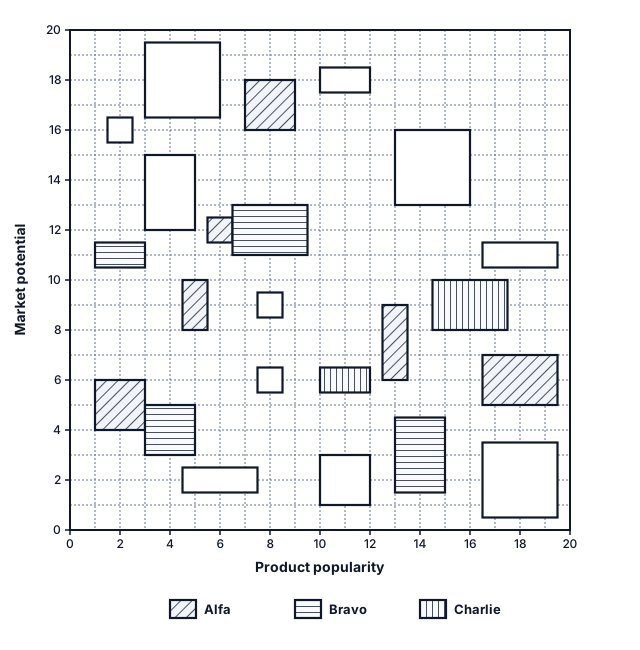
The companies classified their products into four categories based on a combination of scores (out of 20) on the two parameters - Product popularity and Market potential as given below:
| Promising | Blockbuster | Doubtful | No-hope | |
|---|---|---|---|---|
| Product popularity score | > 10 | > 10 | ≤ 10 | ≤ 10 |
| Market potential score | > 10 | ≤ 10 | > 10 | ≤ 10 |
The following facts are known:
- Alfa and Bravo had the same number of products in the Blockbuster category.
- Charlie had more products than Bravo but fewer products than Alfa in the No-hope category.
- Each company had an equal number of products in the Promising category.
- Charlie did not have any product in the Doubtful category, while Alfa had one product more than Bravo in this category.
- Bravo had a higher revenue than Alfa from products in the Doubtful category.
- Charlie had a higher revenue than Bravo from products in the Blockbuster category.
- Bravo and Charlie had the same revenue from products in the No-hope category.
- Alfa and Charlie had the same total revenue considering all products.
Question 23
Which of the following is the correct sequence of numbers of products Bravo had in No-hope, Doubtful, Promising and Blockbuster categories respectively?
Show answer and solution
Answer: (B)
1 , 3 , 1 , 2
Solution
Concept: Strict Integer Partitioning, System-Wide Inequality Resolution & Exact Product Frequency Vectoring
Master State Table
| Category | Definition (Popularity, Potential) | Alfa Products & Sizes | Bravo Products & Sizes | Charlie Products & Sizes | Total Products | Alfa Revenue | Bravo Revenue | Charlie Revenue | Category Revenue |
|---|---|---|---|---|---|---|---|---|---|
| Promising | Popularity , Potential | 1 () | 1 () | 1 () | 3 | 2 | 3 | 9 | 14 |
| Blockbuster | Popularity , Potential | 2 () | 2 () | 3 () | 7 | 9 | 10 | 17 | 36 |
| Doubtful | Popularity , Potential | 4 () | 3 () | 0 (—) | 7 | 12 | 17 | 0 | 29 |
| No-hope | Popularity , Potential | 3 () | 1 () | 2 () | 6 | 7 | 4 | 4 | 15 |
| Total | All 23 Products | 10 Products | 7 Products | 6 Products | 23 | 30 | 34 | 30 | 94 |
Question Deduction
• No-hope Product Count for Bravo:
• No-hope contains 6 products with (Clue 2).
• With 1 pre-shaded Bravo box (), if , the sum exceeds .
• The unique integer partition is , so Bravo has strictly 1 product.
• Doubtful Product Count for Bravo:
• Doubtful has 7 products with and (Clue 4).
• Summing: . Bravo has 3 products.
• Promising Product Count for Bravo:
• Promising has 3 products, equally split across all three companies (Clue 3): . Bravo has 1 product.
• Blockbuster Product Count for Bravo:
• Blockbuster has 7 products with (Clue 1).
• Pre-shaded: Charlie 2, Alfa 2, Bravo 1.
• If , Alfa has 3, requiring (impossible).
• Hence , leaving Charlie with . Bravo has 2 products.
• Vector Assembly & Option Matching:
• Assembling Bravo's counts in sequence (No-hope, Doubtful, Promising, Blockbuster):
$$(N_{\text{No-hope}}, N_{\text{Doubtful}}, N_{\text{Promising}}, N_{\text{Blockbuster}}) = (1, 3, 1, 2)$$
• Matches Option 2 (" 1 , 3 , 1 , 2").
• Distractors fail: Option 1 sets No-hope to ; Option 3 sets No-hope to ; Option 4 sets Blockbuster to .
Topper Take
• Partition triage: In No-hope, summing to 6 forces , locking Bravo at .
• Eliminating Options 1 and 3 immediately, Blockbuster cannot support Bravo products, clinching Option 2 in 20 seconds.
Other questions in this set
- Q21. Considering all companies' products, which product category had the highest revenue?
- Q22. Which of the following statements is NOT correct?
- Q24. If the smallest box on the grid is equivalent to revenue of Rs.1 crore, then what approximately was the total revenue…
Grids questions from other CAT papers
- CAT 2025 Slot 2 DILR Q6
- CAT 2025 Slot 2 DILR Q7
- CAT 2025 Slot 2 DILR Q8
- CAT 2025 Slot 2 DILR Q9
- CAT 2025 Slot 3 DILR Q10
Practise this question with timing, notes and your mistake notebook.
Practise in PrepSoc