CAT 2025 Slot 3 DILR Q16
- Data Interpretation and Logical Reasoning
- Logical Reasoning › Arrangements
- Hard
- Multiple choice
- CAT_2025_SLOT3_DILR_Q16
Data set · questions 14–17
Seven children, Aarav, Bina, Chirag, Diya, Eshan, Farhan, and Gaurav, are sitting in a circle facing inside (not necessarily in the same order) and playing a game of 'Passing the Buck'.
The game is played over 10 rounds. In each round, the child holding the Buck must pass it directly to a child sitting in one of the following positions:
-
Immediately to the left;
-
Immediate to the right;
-
Second to the left; or
-
Second to the right.
The game starts with Bina passing the Buck and ends with Chirag receiving the Buck. The table below provides some information about the pass types and the child receiving the Buck. Some information is missing and labelled as '?'.
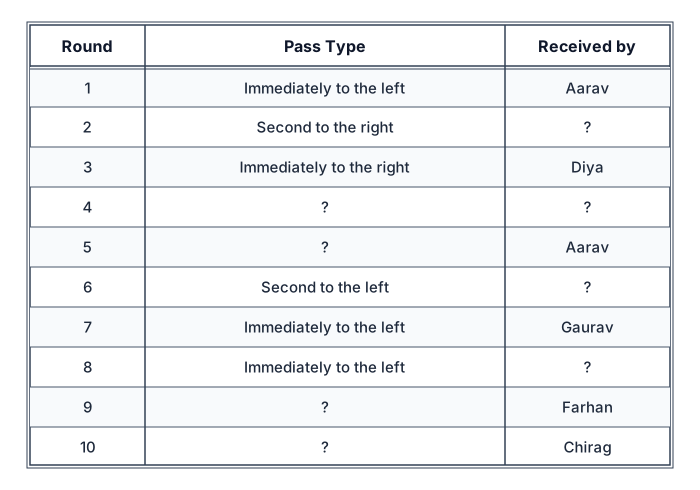
Question 16
For which of the following pass types can the total number of occurrences be uniquely determined?
Show answer and solution
Answer: (D)
Immediately to the right
Solution
Concept: Circular Permutations, Modular Displacements & Token Passing
Master State Table
| Round | Passer (Seat) | Pass Type | Displacement | Receiver (Seat) | Deduction Status |
|---|---|---|---|---|---|
| Start | — | — | — | Bina (0) | Initial game holder |
| 1 | Bina (0) | Immediately to the left | Aarav (1) | Given in table | |
| 2 | Aarav (1) | Second to the right | Eshan (6) | Uniquely deduced: | |
| 3 | Eshan (6) | Immediately to the right | Diya (5) | Given in table: | |
| 4 | Diya (5) | / / | / / | Eshan (6) / Bina (0) / Farhan (3) | 3 feasible branches |
| 5 | Eshan / Bina / Farhan | / / | / / | Aarav (1) | Given receiver: lands on Seat 1 |
| 6 | Aarav (1) | Second to the left | Farhan (3) | Uniquely deduced: | |
| 7 | Farhan (3) | Immediately to the left | Gaurav (4) | Given in table: | |
| 8 | Gaurav (4) | Immediately to the left | Diya (5) | Uniquely deduced: | |
| 9 | Diya (5) | Second to the right | Farhan (3) | Uniquely deduced: | |
| 10 | Farhan (3) | Immediately to the right | Chirag (2) | Uniquely deduced: |
Question Deduction
• Evaluating Option 1 (Second to the left, ):
• Appears once in fixed rounds (Round 6).
• In Branch A and Branch B: Appears once in Rounds 4 & 5, giving total .
• In Branch C: Appears zero times in Rounds 4 & 5, giving total .
• Because the count can be either 1 or 2, it is not uniquely determinable.
• Evaluating Option 2 (Immediately to the left, ):
• Appears 3 times in fixed rounds (Rounds 1, 7, 8).
• In Branch A and Branch B: Appears once in Rounds 4 & 5, giving total .
• In Branch C: Appears zero times in Rounds 4 & 5, giving total .
• Because the count can be either 3 or 4, it is not uniquely determinable.
• Evaluating Option 3 (Second to the right, ):
• Appears 2 times in fixed rounds (Rounds 2, 9).
• In Branch A and Branch B: Appears zero times in Rounds 4 & 5, giving total .
• In Branch C: Appears twice in Rounds 4 & 5, giving total .
• Because the count can be either 2 or 4, it is not uniquely determinable.
• Evaluating Option 4 (Immediately to the right, ):
• Appears 2 times in fixed rounds (Rounds 3, 10).
• In Rounds 4 & 5: The displacement NEVER occurs in Branch A (), Branch B (), or Branch C ().
• Across all three feasible branches, the total number of occurrences of "Immediately to the right" is strictly:
• This count is invariant and uniquely determined!
• Final Selection: Option 4.
Topper Take
• The Modulo Wrap-Around Blindspot: Many students find and because , and stop their search, falsely believing these are the only cases. In both of those cases, the pass frequencies happen to be identical (4 of , 2 of , 2 of , 2 of ). A student who misses Branch C might believe all four pass types are uniquely determined and become paralyzed by the options!
• The Negative Modular Identity: Recognizing that introduces Branch C, which disrupts the counts of , , and , leaving only (Immediately to the right) invariant.
Other questions in this set
- Q14. Who is sitting immediately to the right of Bina?
- Q15. Who is sitting third to the left of Eshan?
- Q17. For which of the following children is it possible to determine how many times they received the Buck?
Arrangements questions from other CAT papers
- CAT 2024 Slot 2 DILR Q1
- CAT 2024 Slot 2 DILR Q2
- CAT 2024 Slot 2 DILR Q3
- CAT 2024 Slot 2 DILR Q4
- CAT 2024 Slot 2 DILR Q5
Practise this question with timing, notes and your mistake notebook.
Practise in PrepSoc