CAT 2024 Slot 2 DILR Q6
- Data Interpretation and Logical Reasoning
- Logical Reasoning › Grids
- Hard
- Multiple choice
- CAT_2024_SLOT2_DILR_Q06
Data set · questions 6–9
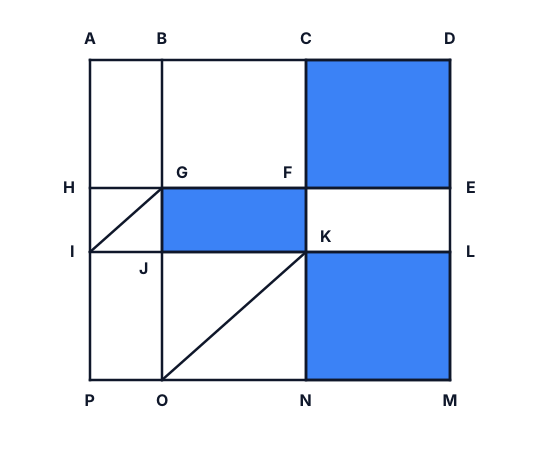
The above is a schematic diagram of walkways (indicated by all the straight lines) and lakes (3 of them, each in the shape of rectangles - shaded in the diagram) of a gated area. Different points on the walkway are indicated by letters (A through P) with distances being OP = 150 m, ON = MN = 300 m, ML = 400 m, EL = 200 m, DE = 400 m.
The following additional information about the facilities in the area is known.
- The only entry/exit point is at C.
- There are many residences within the gated area; all of them are located on the path AH and ML with four of them being at A, H, M, and L.
- The post office is located at P and the bank is located at B.
Question 6
One resident whose house is located at L, needs to visit the post office as well as the bank. What is the minimum distance (in m) he has to walk starting from his residence and returning to his residence after visiting both the post office and the bank?
Show answer and solution
Answer: (A)
3200
Solution
Concept: Shortest Path Network Routing / Hypotenuse Optimization in Planar Graphs
Master State Table
| Segment Category | Pathway Segments | Length (m) | Structural Description / Topological Role |
|---|---|---|---|
| Horizontal (East-West) | Left corridor width () | ||
| Central corridor width (, Lake 2 top/bottom) | |||
| Right corridor width (, Lakes 1 & 3 top/bottom) | |||
| Vertical (North-South) | Top tier height (, Lake 1 east/west) | ||
| Middle tier height (, Lake 2 east/west) | |||
| Bottom tier height (, Lake 3 east/west) | |||
| Diagonal Hypotenuse | Shortcut across / () | ||
| Shortcut across () |
Question Deduction
• Objective & Facility Mapping:
-
The resident starts at residence , visits the post office at and the bank at , and returns to .
-
This requires the minimum round-trip closed tour visiting checkpoints: .
• Leg 1 ( to ) — Diagonal Optimization:
-
Moving from to spans west and south.
-
Path: .
-
Traversing diagonal yields , saving compared to the rectangular route .
-
Subtotal: .
• Leg 2 ( to ) — Diagonal Optimization:
-
Moving from to spans east and north.
-
Path: .
-
Traversing diagonal yields , saving compared to .
-
Subtotal: .
• Leg 3 ( to ) — Grid Corridor Traverse:
-
Moving from to spans east and south. Because diagonals and orient southwest-to-northeast, neither provides a shortcut for southeast transit.
-
Shortest grid path: (or / ).
-
Subtotal: .
• Total Closed Tour Distance:
- This matches Option 1 ().
Topper Take
• Hypotenuse Routing: Decompose the tour into three independent shortest paths (, , ). Deploying the right-triangle shortcuts (, ) immediately locks the minimum without testing redundant loops.
Other questions in this set
- Q7. One person enters the gated area and decides to walk as much as possible before leaving the area without walking along…
- Q8. One resident takes a walk within the gated area starting from A and returning to A without going through any point…
- Q9. Visitors coming for morning walks are allowed to enter as long as they do not pass by any of the residences and do not…
Grids questions from other CAT papers
- CAT 2025 Slot 2 DILR Q6
- CAT 2025 Slot 2 DILR Q7
- CAT 2025 Slot 2 DILR Q8
- CAT 2025 Slot 2 DILR Q9
- CAT 2025 Slot 3 DILR Q10
Practise this question with timing, notes and your mistake notebook.
Practise in PrepSoc