CAT 2023 Slot 2 DILR Q15
- Data Interpretation and Logical Reasoning
- Logical Reasoning › Grids
- Hard
- Type in the answer (TITA)
- CAT_2023_SLOT2_DILR_Q15
Data set · questions 11–15
There are nine boxes arranged in a array as shown in Tables 1 and 2. Each box contains three sacks. Each sack has a certain number of coins, between 1 and 9, both inclusive.
The average number of coins per sack in the boxes are all distinct integers. The total number of coins in each row is the same. The total number of coins in each column is also the same.
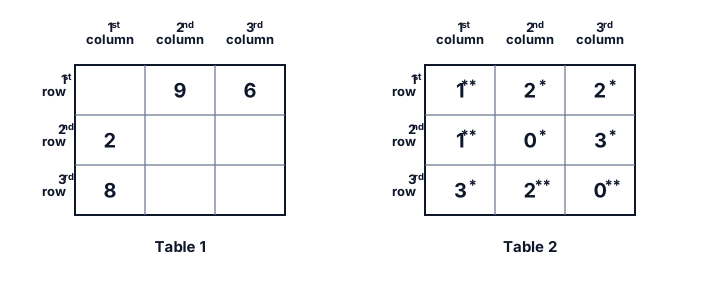
Table 1 gives information regarding the median of the numbers of coins in the three sacks in a box for some of the boxes. In Table 2 each box has a number which represents the number of sacks in that box having more than 5 coins. That number is followed by a, if the sacks in that box satisfy exactly one among the following three conditions, and it is followed by. if two or more of these conditions are satisfied.
i) The minimum among the numbers of coins in the three sacks in the box is 1.
ii) The median of the numbers of coins in the three sacks is 1.
iii) The maximum among the numbers of coins in the three sacks in the box is 9.
Question 15
In how many boxes do all three sacks contain different numbers of coins?
Type-in-the-answer (TITA) question: no options are given; enter the value.
Show answer and solution
Answer:
5
Solution
Concept: Latin Hypercube Constraint Logic, Multiset Statistics & Integer Permutations
Master State Table
| Row \ Col | Column 1 | Column 2 | Column 3 | Row Coins Sum | Row Average Coins |
|---|---|---|---|---|---|
| Row 1 | Box(1,1): (Sum 9, Avg 3) | Box(1,2): (Sum 21, Avg 7) | Box(1,3): (Sum 15, Avg 5) | 45 | 15 |
| Row 2 | Box(2,1): (Sum 12, Avg 4) | Box(2,2): (Sum 6, Avg 2) | Box(2,3): (Sum 27, Avg 9) | 45 | 15 |
| Row 3 | Box(3,1): (Sum 24, Avg 8) | Box(3,2): (Sum 18, Avg 6) | Box(3,3): (Sum 3, Avg 1) | 45 | 15 |
| Col Sum | 45 | 45 | 45 | 135 | — |
Question Deduction
• Target Condition: Number of boxes where all three sacks contain pairwise distinct numbers of coins.
• Evaluating Distinctness across the 9 Boxes:
• Box(1,1): Duplicate 1s (Not all distinct).
• Box(1,2): Duplicate 9s (Not all distinct).
• Box(1,3): All distinct (Box 1).
• Box(2,1): All distinct (Box 2).
• Box(2,2): All distinct (Box 3).
• Box(2,3): All identical (Not all distinct).
• Box(3,1): All distinct (Box 4).
• Box(3,2): All distinct (Box 5).
• Box(3,3): All identical (Not all distinct).
• Conclusion:
• Exactly 5 boxes have all three sacks containing different numbers of coins.
• Numerical Answer:
• 5.
Topper Take
• Complementary Elimination: Count boxes with duplicates: Box(1,1), Box(1,2), Box(2,3), Box(3,3) (4 boxes). Thus, boxes have all three sacks distinct.
Other questions in this set
- Q11. What is the total number of coins in all the boxes in the 3rd row?
- Q12. How many boxes have at least one sack containing 9 coins?
- Q13. For how many boxes are the average and median of the numbers of coins contained in the three sacks in that box the same?
- Q14. How many sacks have exactly one coin?
Grids questions from other CAT papers
- CAT 2025 Slot 2 DILR Q6
- CAT 2025 Slot 2 DILR Q7
- CAT 2025 Slot 2 DILR Q8
- CAT 2025 Slot 2 DILR Q9
- CAT 2025 Slot 3 DILR Q10
Practise this question with timing, notes and your mistake notebook.
Practise in PrepSoc