CAT 2023 Slot 1 DILR Q19
- Data Interpretation and Logical Reasoning
- Logical Reasoning › Grids
- Hard
- Type in the answer (TITA)
- CAT_2023_SLOT1_DILR_Q19
Data set · questions 16–20
The schematic diagram below shows 12 rectangular houses in a housing complex. House numbers are mentioned in the rectangles representing the houses. The houses are located in six columns – Column-A through Column-F, and two rows – Row-1 and Row-2. The houses are divided into two blocks - Block XX and Block YY. The diagram also shows two roads, one passing in front of the houses in Row-2 and another between the two blocks.
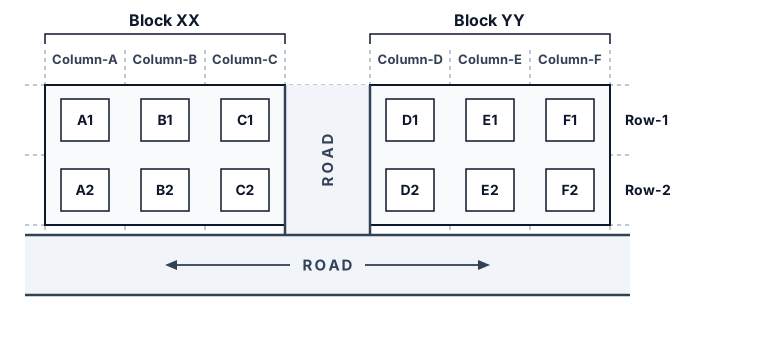
Some of the houses are occupied. The remaining ones are vacant and are the only ones available for sale.
The road adjacency value of a house is the number of its sides adjacent to a road. For example, the road adjacency values of C2, F2, and B1 are 2, 1, and 0, respectively. The neighbour count of a house is the number of sides of that house adjacent to occupied houses in the same block. For example, E1 and C1 can have the maximum possible neighbour counts of 3 and 2, respectively.
The base price of a vacant house is Rs. 10 lakhs if the house does not have a parking space, and Rs. 12 lakhs if it does. The quoted price (in lakhs of Rs.) of a vacant house is calculated as (base price) + 5 (road adjacency value) + 3 (neighbour count).
The following information is also known.
- The maximum quoted price of a house in Block XX is Rs. 24 lakhs. The minimum quoted price of a house in block YY is Rs. 15 lakhs, and one such house is in Column-E.
- Row-1 has two occupied houses, one in each block.
- Both houses in Column-E are vacant. Each of Column-D and Column-F has at least one occupied house.
- There is only one house with parking space in Block YY.
Question 19
What is the maximum possible quoted price (in lakhs of Rs.) for a vacant house in Column-E? (in numerial value)
Type-in-the-answer (TITA) question: no options are given; enter the value.
Show answer and solution
Answer:
21
Solution
Concept: Geometric Adjacency Modeling, Boundary Constraints & Diophantine Price Optimization
Master State Table
| Block | House ID | Grid Position | Status | Parking Space | Road Adjacency () | Occupied Neighbor Count () | Formula / Quoted Price (₹ Lakhs) |
|---|---|---|---|---|---|---|---|
| XX | A1 | Row-1, Col-A | Vacant | Yes | 0 | 2 (B1, A2) | |
| XX | B1 | Row-1, Col-B | Occupied | — | 0 | — | — (Not for sale) |
| XX | C1 | Row-1, Col-C | Vacant | No | 1 (Inter-block road) | 2 (B1, C2) | |
| XX | A2 | Row-2, Col-A | Occupied | — | 1 (Front road) | — | — (Not for sale) |
| XX | B2 | Row-2, Col-B | Vacant | No | 1 (Front road) | 3 (A2, B1, C2) | (Max in XX) |
| XX | C2 | Row-2, Col-C | Occupied | — | 2 (Front & inter-block) | — | — (Not for sale) |
| YY | D1 | Row-1, Col-D | Vacant | No | 1 (Inter-block road) | 1 (D2) | |
| YY | E1 | Row-1, Col-E | Vacant | Yes (Only one in YY) | 0 | 1 (F1) | (Min in YY) |
| YY | F1 | Row-1, Col-F | Occupied | — | 0 | — | — (Not for sale) |
| YY | D2 | Row-2, Col-D | Occupied | — | 2 (Front & inter-block) | — | — (Not for sale) |
| YY | E2 | Row-2, Col-E | Vacant | No | 1 (Front road) | 1 or 2 (D2, and F2 if occ.) | |
| YY | F2 | Row-2, Col-F | Indeterminate | No | 1 (Front road) | 1 (F1) if vacant | (if vacant) |
Question Deduction
• Column-E Houses:
• Both E1 and E2 are vacant (Clue 3).
• Evaluating Quoted Price for House E1:
• E1 has parking space (deduced as the unique house with parking in YY to attain the minimum price of 15 lakhs: ).
• Price of E1 is fixed at 15 lakhs.
• Evaluating Quoted Price for House E2:
• E2 has no parking space (Base price ).
• E2 is in Row-2, adjacent to the front road .
• E2's neighbors are D2, E1, and F2:
• D2 is Occupied ($+1$).

• E1 is Vacant ($0$).

• F2 can be Occupied ($+1$) or Vacant ($0$).
• Maximum neighbor count occurs when F2 is occupied: .
• Calculating Maximum Price:
• Numerical Answer:
• 21.
Topper Take
• Maximize Variables: E2 has road adjacency and no parking (base ). Its occupied neighbor count is at most 2 (D2 and F2). lakhs.
Other questions in this set
- Q16. How many houses are vacant in Block XX? (in numerial value)
- Q17. Which of the following houses is definitely occupied?
- Q18. Which of the following options best describes the number of vacant houses in Row-2?
- Q20. Which house in Block YY has parking space?
Grids questions from other CAT papers
- CAT 2025 Slot 2 DILR Q6
- CAT 2025 Slot 2 DILR Q7
- CAT 2025 Slot 2 DILR Q8
- CAT 2025 Slot 2 DILR Q9
- CAT 2025 Slot 3 DILR Q10
Practise this question with timing, notes and your mistake notebook.
Practise in PrepSoc