CAT 2022 Slot 1 DILR Q19
- Data Interpretation and Logical Reasoning
- Logical Reasoning › Routes & Networks
- Easy
- Type in the answer (TITA)
- CAT_2022_SLOT1_DILR_Q19
Data set · questions 16–20
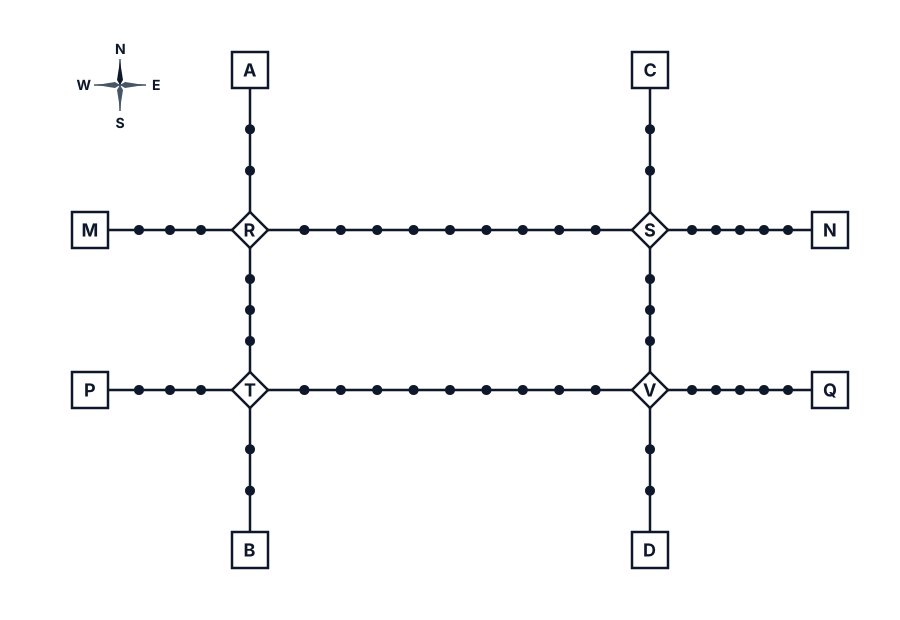
Given above is the schematic map of the metro lines in a city with rectangles denoting terminal stations (e.g. A), diamonds denoting junction stations (e.g. R) and small filled-up circles denoting other stations. Each train runs either in east-west or north-south direction, but not both. All trains stop for 2 minutes at each of the junction stations on the way and for 1 minute at each of the other stations. It takes 2 minutes to reach the next station for trains going in east-west direction and 3 minutes to reach the next station for trains going in north- south direction. From each terminal station, the first train starts at 6 am; the last trains leave the terminal stations at midnight. Otherwise, during the service hours, there are metro service every 15 minutes in the north-south lines and every 10 minutes in the east-west lines. A train must rest for at least 15 minutes after completing a trip at the terminal station, before it can undertake the next trip in the reverse direction. (All questions are related to this metro service only. Assume that if someone reaches a station exactly at the time a train is supposed to leave, she can catch that train).
Question 19
What is the minimum number of trains that are required to provide the service on the AB line (considering both north and south directions)?
Type-in-the-answer (TITA) question: no options are given; enter the value.
Show answer and solution
Answer:
8
Solution
Concept: Periodic Network Scheduling, Transfer Optimization & Turnaround Fleet Sizing
Master State Table
| Line / Corridor | Direction | Inter-Station Run Time | Junction Stop | Regular Stop | One-Way Journey Time | Headway | Turnaround Rest | Cycle Time | Trains Required per Corridor |
|---|---|---|---|---|---|---|---|---|---|
| E-W (M-N) | East-West | 2 min | 2 min | 1 min | 61 min | 10 min | 15 min | 152 min | 16 trains |
| E-W (P-Q) | East-West | 2 min | 2 min | 1 min | 61 min | 10 min | 15 min | 152 min | 16 trains |
| N-S (A-B) | North-South | 3 min | 2 min | 1 min | 41 min | 15 min | 15 min | 112 min | 8 trains |
| N-S (C-D) | North-South | 3 min | 2 min | 1 min | 41 min | 15 min | 15 min | 112 min | 8 trains |
| Network Total | — | — | — | — | — | — | — | — | 48 trains total |
Question Deduction
• Fleet Sizing Principle for Periodic Corridors:
• To maintain an unbroken regular service, the number of train sets required on a corridor equals:
$$N = \left\lceil \frac{\text{Round-Trip Cycle Time}}{\text{Headway}} \right\rceil$$
• Computing Cycle Time for Line A-B:
• Headway on North-South lines: 15 minutes.
• Run time from A to B:
• A to R: 11 min.

• Halt at R: 2 min.

• R to T: 15 min.

• Halt at T: 2 min.

• T to B: 11 min.

• One-way trip time $= 11 + 2 + 15 + 2 + 11 = 41$ minutes.
• Mandatory rest time at terminal B: 15 minutes.
• Run time from B to A: 41 minutes.
• Mandatory rest time at terminal A: 15 minutes.
• Full round-trip cycle time:
$$\text{Cycle Time} = 41 + 15 + 41 + 15 = 112 \text{ minutes}$$
• Calculating Required Fleet:
• Numerical Answer:
• 8.
Topper Take
• Fleet Sizing Formula: Cycle time min. Dividing by 15-min headway yields trains.
Other questions in this set
- Q16. If Hari is ready to board a train at 8:05 am from station M, then when is the earliest that he can reach station N?
- Q17. If Priya is ready to board a train at 10:25 am from station T, then when is the earliest that she can reach station S?
- Q18. Haripriya is expected to reach station S late. What is the latest time by which she must be ready to board at station…
- Q20. What is the minimum number of trains that are required to provide the service in this city?
Routes & Networks questions from other CAT papers
- CAT 2023 Slot 3 DILR Q11
- CAT 2023 Slot 3 DILR Q12
- CAT 2023 Slot 3 DILR Q13
- CAT 2023 Slot 3 DILR Q14
- CAT 2023 Slot 3 DILR Q15
Practise this question with timing, notes and your mistake notebook.
Practise in PrepSoc