CAT 2020 Slot 3 DILR Q19
- Data Interpretation and Logical Reasoning
- Logical Reasoning › Grids
- Hard
- Multiple choice
- CAT_2020_SLOT3_DILR_Q19
Data set · questions 19–24
A farmer had a rectangular land containing 205 trees. He distributed that land among his four daughters – Abha, Bina, Chitra and Dipti by dividing the land into twelve plots along three rows (X,Y,Z) and four Columns (1,2,3,4) as shown in the figure below:
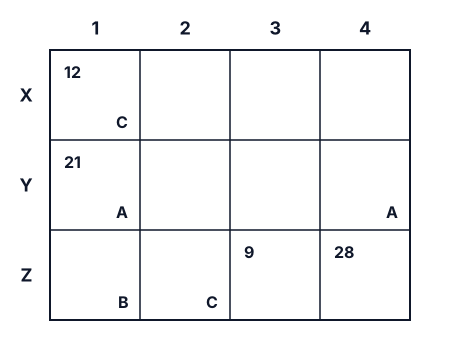
The plots in rows X, Y, Z contained mango, teak and pine trees respectively. Each plot had trees in non-zero multiples of 3 or 4 and none of the plots had the same number of trees. Each daughter got an even number of plots. In the figure, the number mentioned in top left corner of a plot is the number of trees in that plot, while the letter in the bottom right corner is the first letter of the name of the daughter who got that plot (For example, Abha got the plot in row Y and column 1 containing 21 trees). Some information in the figure got erased, but the following is known:
- Abha got 20 trees more than Chitra but 6 trees less than Dipti.
- The largest number of trees in a plot was 32, but it was not with Abha.
- The number of teak trees in Column 3 was double of that in Column 2 but was half of that in Column 4.
- Both Abha and Bina got a higher number of plots than Dipti.
- Only Bina, Chitra and Dipti got corner plots.
- Dipti got two adjoining plots in the same row.
- Bina was the only one who got a plot in each row and each column.
- Chitra and Dipti did not get plots which were adjacent to each other (either in row / column / diagonal).
- The number of mango trees was double the number of teak trees.
Question 19
How many mango trees were there in total?
Show answer and solution
Answer: (B)
98
Solution
Concept: Multi-Attribute Grid Modeling, Parity-Based Plot Allocation & Linear Invariant Solving
Master State Table
| Row / Tree Variety | Column 1 | Column 2 | Column 3 | Column 4 | Row Total | Daughter Subtotals |
|---|---|---|---|---|---|---|
| Row X (Mango) | 12 (Chitra) | 30 (Bina) | 32 or 24 (Dipti) | 24 or 32 (Dipti) | 98 | Dipti: 56 • Bina: 30 • Chitra: 12 |
| Row Y (Teak) | 21 (Abha) | 4 (Abha) | 8 (Bina) | 16 (Abha) | 49 | Abha: 41 • Bina: 8 |
| Row Z (Pine) | 3 (Bina) | 18 (Chitra) | 9 (Abha) | 28 (Bina) | 58 | Bina: 31 • Chitra: 18 • Abha: 9 |
| Column Total | 36 | 52 | 41 or 49 | 68 or 76 | 205 | Grand Totals: Abha: 50 • Bina: 69 • Chitra: 30 • Dipti: 56 |
Question Deduction
• Plot Parity & Distribution:
• The 12 plots are divided among 4 daughters, with each daughter receiving an even number of plots.
• By Clue 4, Abha and Bina each received more plots than Dipti.
• If Dipti had plots, Abha and Bina would need each (). Hence, Dipti has exactly 2 plots.
• With Dipti , Abha , Bina , and Chitra receiving an even count , the unique integer partition of 12 plots is: Dipti , Chitra , Abha , and Bina .
• Teak Progression & Uniqueness (Row Y):
• Plot contains 21 teak trees (Abha).
• By Clue 3, teak trees in Column 3 are double those in Column 2 and half of Column 4:
$$Y2 = a, \quad Y3 = 2a, \quad Y4 = 4a$$
• All plot tree counts must be distinct, non-zero multiples of 3 or 4.
• By Clue 2, the largest plot count is 32 and not with Abha; thus .
• If , then , which duplicates (given in diagram).
• If , then , which again duplicates .
• For : . All counts are valid and distinct from .
• Thus, uniquely holds.
• Computing Total Mango Trees:
• Total teak trees in Row Y:
$$\sum Y = 21 + 4 + 8 + 16 = 49\text{ trees}$$
• By Clue 9, mango trees (Row X) are double the teak trees:
$$\sum X = 2 \times \sum Y = 2 \times 49 = 98\text{ trees}$$
• Option Matching:
• Matches Option 2 (98).
• Distractor check: Option 1 (49) is the teak total; Option 3 (126) and Option 4 (84) stem from invalid ratios or erroneous teak bases.
Topper Take
• Fast Row Isolation: Clue 3 yields teak counts as . The uniqueness rule quickly eliminates and against , locking .
• Teak total is , immediately giving mango trees without needing the full grid solved.
Other questions in this set
- Q20. Which of the following is the correct sequence of trees received by Abha, Bina, Chitra and Dipti in that order?
- Q21. How many pine trees did Chitra receive?
- Q22. Who got the plot with the smallest number of trees and how many trees did that plot have?
- Q23. Which of the following statements is NOT true?
- Q24. Which column had the highest number of trees?
Grids questions from other CAT papers
- CAT 2025 Slot 2 DILR Q6
- CAT 2025 Slot 2 DILR Q7
- CAT 2025 Slot 2 DILR Q8
- CAT 2025 Slot 2 DILR Q9
- CAT 2025 Slot 3 DILR Q10
Practise this question with timing, notes and your mistake notebook.
Practise in PrepSoc