CAT 2019 Slot 2 DILR Q5
- Data Interpretation and Logical Reasoning
- Logical Reasoning › Grids
- Medium
- Type in the answer (TITA)
- CAT_2019_SLOT2_DILR_Q05
Data set · questions 5–8
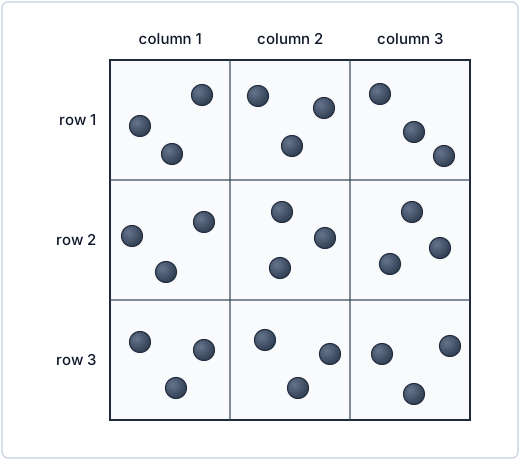
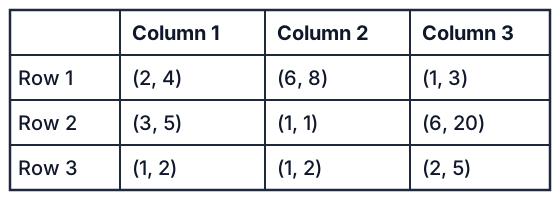
Three pouches (each represented by a filled circle) are kept in each of the nine slots in a grid, as shown in the figure. Every pouch has a certain number of one-rupee coins. The minimum and maximum amounts of money (in rupees) among the three pouches in each of the nine slots are given in the table. For example, we know that among the three pouches kept in the second column of the first row, the minimum amount in a pouch is Rs. 6 and the maximum amount is Rs. 8.
There are nine pouches in any of the three columns, as well as in any of the three rows. It is known that the average amount of money (in rupees) kept in the nine pouches in any column or in any row is an integer. Hence the sum of nine pouches in any row or column should be a multiple of 9. It is also known that the total amount of money kept in the three pouches in the first column of the third row is Rs. 4.
Question 5
What is the total amount of money (in rupees) in the three pouches kept in the first column of the second row?
Type-in-the-answer (TITA) question: no options are given; enter the value.
Show answer and solution
Answer:
13
Solution
Concept: Divisibility Invariants, Bounded Integer Partitions & Column Sum Extremum Analysis
Master State Table
| Grid Position | Column 1 | Column 2 | Column 3 | Row Sum () | Row Mean () |
|---|---|---|---|---|---|
| Row 1 | Slot(1,1): Bounds (Sum ) | Slot(1,2): Bounds (Sum ) | Slot(1,3): Bounds (Sum ) | 36 | 4 |
| Row 2 | Slot(2,1): Bounds (Sum ) | Slot(2,2): Bounds (Sum ) | Slot(2,3): Bounds (Sum ) | 54 | 6 |
| Row 3 | Slot(3,1): Bounds (Sum ) | Slot(3,2): Bounds (Sum ) | Slot(3,3): Bounds (Sum ) | 18 | 2 |
| Col Sum () | 27 | 27 | 54 | Total = 108 | — |
| Col Mean () | 3 | 3 | 6 | — | Avg = 4 |
Question Deduction
• Grid Structure & Conservation Rules:
• The grid has 9 slots, each holding 3 pouches of ₹1 coins (27 pouches total).
• For slot with bounds , middle pouch yields total .
• The integer average condition requires each row sum and column sum across its 9 pouches to be a multiple of 9 ().
• Column 1 Boundary Constraints:
• Row 3, Column 1 total is given as Rs. 4 (). Bounds .
• Slot (1,1): Bounds .
• Slot (2,1): Bounds .
• Column 1 total: .
• Unique Divisibility Determination for Row 2, Column 1:
• In , the only multiple of 9 is 27 ().
• Achieving requires both slots to hit their theoretical maxima:
$$T_{1,1} = 10 \implies x_{1,1} = 4 \implies \{2, 4, 4\}$$

$$T_{2,1} = 13 \implies x_{2,1} = 5 \implies \{3, 5, 5\}$$
• This uniquely fixes the total amount in Row 2, Column 1 at Rs. 13.
• Option Matching / Numerical Answer:
• The total amount in the three pouches kept in the first column of the second row is 13.
• Numerical Answer: 13.
Topper Take
• Column 1 Extremum Shortcut: Column 1 sum is bounded by . The unique multiple of 9 is 27, which demands both Slot(1,1) and Slot(2,1) to achieve their absolute upper bounds (10 and 13). Solved in under 60 seconds without solving the rest of the grid!
Other questions in this set
- Q6. How many pouches contain exactly one coin?
- Q7. What is the number of slots for which the average amount (in rupees) of its three pouches is an integer?
- Q8. The number of slots for which the total amount in its three pouches strictly exceeds Rs. 10 is
Grids questions from other CAT papers
- CAT 2025 Slot 2 DILR Q6
- CAT 2025 Slot 2 DILR Q7
- CAT 2025 Slot 2 DILR Q8
- CAT 2025 Slot 2 DILR Q9
- CAT 2025 Slot 3 DILR Q10
Practise this question with timing, notes and your mistake notebook.
Practise in PrepSoc