CAT 2019 Slot 1 DILR Q3
- Data Interpretation and Logical Reasoning
- Logical Reasoning › Coding/Decoding
- Easy
- Type in the answer (TITA)
- CAT_2019_SLOT1_DILR_Q03
Data set · questions 1–4
The following table represents addition of two six-digit numbers given in the first and the second rows, while the sum is given in the third row. In the representation, each of the digits 0, 1, 2, 3, 4, 5, 6, 7, 8, 9 has been coded with one letter among A, B, C, D, E, F, G, H, J, K, with distinct letters representing distinct digits.
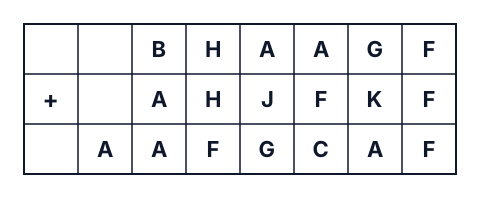
Question 3
Which among the digits 3, 4, 6 and 7 cannot be represented by the letter D?
Type-in-the-answer (TITA) question: no options are given; enter the value.
Show answer and solution
Answer:
7
Solution
Concept: Branch Pruning, Permutation Domain Exhaustion & Invariant Exclusion Proof
Master State Table
| Letter | Digit | Determination Status | Governing Constraint |
|---|---|---|---|
| A | 1 | Determined | Leading sum overflow () into Col 7 |
| B | 9 | Determined | Col 6: |
| C | 2 | Determined | Col 3: () |
| D | Branch-Dependent | Off-grid residual pair with across valid branches | |
| E | Branch-Dependent | Off-grid residual pair with across valid branches | |
| F | 0 | Determined | Col 1: () |
| G | Branch-Dependent | Cols 2 & 4: | |
| H | 5 | Determined | Col 5: () |
| J | Branch-Dependent | Col 4: | |
| K | Branch-Dependent | Col 2: |
Question Deduction
• Committed Invariants & Residual Variable Pool:
• Passage invariants uniquely fix five letters: .
• Committed digits: ; unassigned letters: ; available digits: .
• Coupled Constraints on Grid Letters {G, J, K}:
• Column 2: ; Column 4: .
• Pruning :
• $G = 3 \implies J = 2$ (conflicts with $C = 2$); $G = 6 \implies K = 5$ (conflicts with $H = 5$).

• Feasible $(G, J, K)$ triples: $(4, 3, 7)$, $(7, 6, 4)$, $(8, 7, 3)$.
• Branch Analysis for Residual Pair {D, E}:
• Off-grid letters take residual digits across the three branches:
• $(4, 3, 7) \implies D \in \{6, 8\}$; $(7, 6, 4) \implies D \in \{3, 8\}$; $(8, 7, 3) \implies D \in \{4, 6\}$.
• Across all valid branches, .
• Impossibility Proof for Digit 7:
• In every valid branch, digit is claimed by an active grid letter ( or ).
• Because is perpetually occupied by , it is never available for .
• Thus, among , digit cannot be represented by .
• Option Matching / Numerical Answer:
• The digit that cannot be represented by the letter is .
• Official numerical response: 7.
Topper Take
• Off-Grid Exclusion: Across all three branches, digit is claimed by active grid letters ( or ). Because is never residual, off-grid letter can never equal .
• Speed Shortcut: Partitioning with and requires in every branch, eliminating candidate instantly.
Other questions in this set
- Q1. Which digit does the letter A represent?
- Q2. Which digit does the letter B represent?
- Q4. Which among the digits 4, 6, 7 and 8 cannot be represented by the letter G?
Coding/Decoding questions from other CAT papers
Practise this question with timing, notes and your mistake notebook.
Practise in PrepSoc